
Ocean vs Air Freight: How Exporters Can Choose the Right Shipping Mode
Compare ocean and air freight across cost, transit time, cargo requirements and operational considerations to choose the right transportation approach for international shipments.
Introduction
Choosing the right transportation mode is an important part of international export planning. For many exporters, the decision comes down to two primary options: ocean freight or air freight.
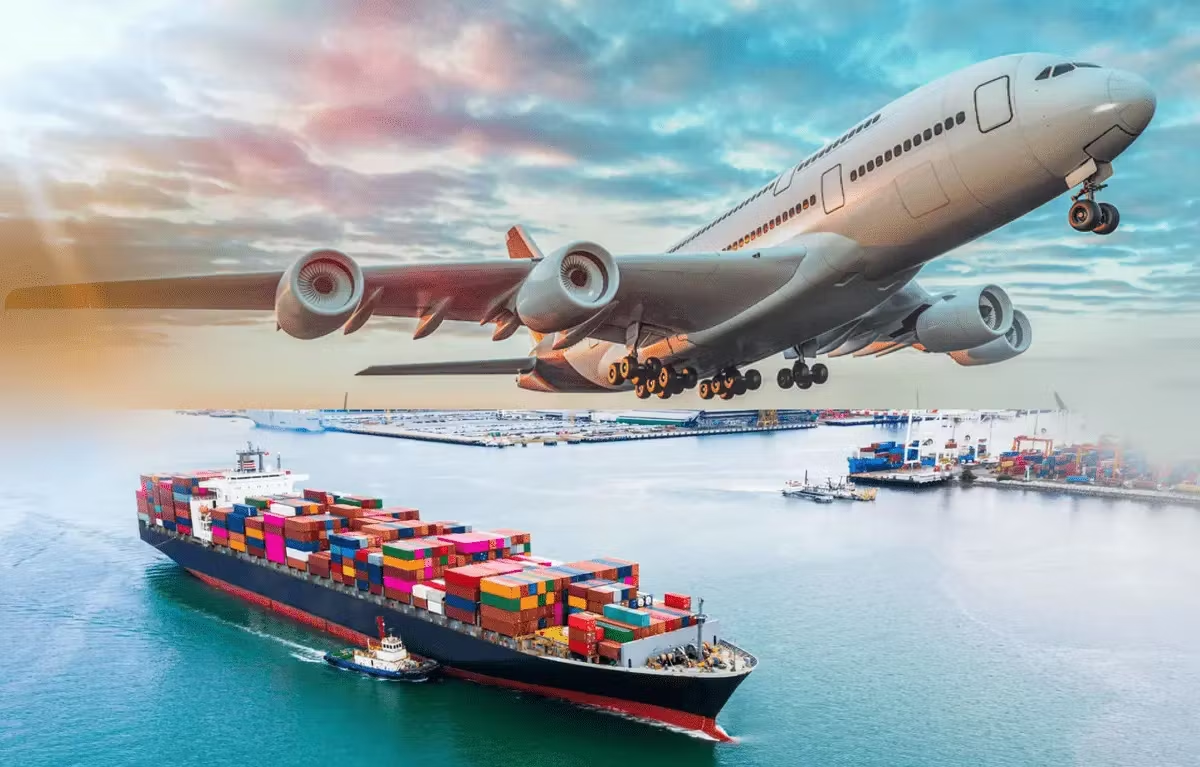
Both modes connect businesses with international markets, but they serve different operational requirements. Ocean freight is commonly considered for larger shipments and cost-sensitive transportation, while air freight can be useful when speed and shorter transit times are important.
The right choice depends on factors such as cargo volume, shipment weight, urgency, destination, product characteristics and overall logistics requirements.
What Is Ocean Freight?
Ocean freight involves transporting cargo between countries using container ships and other maritime transportation networks.
Exporters can use ocean shipping for a wide range of cargo, from manufactured products and machinery to raw materials and commercial goods.
Depending on the shipment size and requirements, exporters may use:
- Full Container Load (FCL)
- Less than Container Load (LCL)
- Containerized cargo
- Consolidated shipments
- Multimodal transportation connected with road or rail
Ocean freight is particularly relevant when shipment volume is large and transit time can be planned in advance.
What Is Air Freight?
Air freight involves transporting cargo through commercial or dedicated cargo aircraft.
Compared with ocean transportation, air freight generally provides shorter transit times and can be suitable for shipments where delivery speed is an important consideration.
Common applications include:
- Time-sensitive commercial shipments
- High-value products
- Samples and prototypes
- Electronics
- Urgent replacement parts
- Smaller international consignments
Because aircraft capacity and operating costs are different from maritime transportation, air freight needs to be evaluated carefully against shipment economics.
Ocean Freight vs Air Freight
The most important differences can be considered across several factors.
| Factor | Ocean Freight | Air Freight |
|---|---|---|
| Transit Time | Generally longer | Generally shorter |
| Shipment Volume | Suitable for larger volumes | Better suited to smaller or urgent shipments |
| Cost Consideration | Often more economical for large cargo volumes | Usually higher transportation cost |
| Cargo Planning | Requires advance planning | Useful when faster movement is required |
| Shipment Frequency | Suitable for planned international supply chains | Useful for time-sensitive requirements |
| Cargo Type | Wide range of commercial cargo | Often used for lighter or high-value cargo |
| Tracking | Shipment visibility available through logistics providers | Shipment tracking available through logistics providers |
The final decision should be based on the complete logistics requirement rather than transportation cost alone.
When Should Exporters Choose Ocean Freight?
Ocean freight can be considered when the shipment involves:
Large Cargo Volumes
When an exporter needs to move a significant quantity of goods, containerized ocean transportation can provide an appropriate solution.
Cost-Sensitive Shipments
For certain large-volume shipments, ocean freight may provide a more economical transportation approach compared with air freight.
Planned Inventory Movement
Businesses with predictable production and delivery schedules can plan ocean shipments around their inventory requirements.
Non-Urgent Cargo
If the cargo does not require rapid delivery, exporters can evaluate ocean transportation as part of their international logistics strategy.
When Should Exporters Choose Air Freight?
Air freight can be considered when speed is an important requirement.
Time-Sensitive Cargo
Businesses dealing with urgent shipments may consider air transportation when shorter transit times are required.
Smaller Shipments
For certain smaller consignments, air freight can provide operational flexibility when compared with arranging a full ocean container.
High-Value Products
Some high-value products may require faster transportation and closer shipment management.
Urgent Business Requirements
Replacement parts, samples or time-sensitive commercial requirements may make air freight a practical option.
Cost vs Speed: The Main Trade-Off
One of the biggest differences between ocean and air freight is the relationship between transportation cost and delivery speed.
Ocean freight generally works well when businesses are moving larger quantities and have sufficient time for transportation.
Air freight focuses more strongly on speed, but exporters need to evaluate whether the faster delivery justifies the additional transportation expense.
Therefore, exporters should avoid choosing a transportation mode based only on the quoted freight rate.
The complete logistics cost may also involve:
- Customs clearance
- Documentation
- Handling charges
- Warehousing
- Inland transportation
- Insurance
- Port or airport-related charges
- Storage
- Delivery to the final destination
Consider the Nature of Your Cargo
The product itself should also influence the transportation decision.
Before selecting a freight mode, exporters should evaluate:
Weight and volume
How much cargo needs to be transported?
Product value
Is the cargo high-value or relatively low-value?
Urgency
How quickly does the shipment need to reach the destination?
Product sensitivity
Does the cargo require special handling or temperature control?
Destination
What transportation connections are available between the origin and destination?
Delivery schedule
Does the shipment need to meet a specific production or customer deadline?
FCL vs LCL for Ocean Shipments
Exporters using ocean freight may also need to decide between FCL and LCL.
FCL — Full Container Load
FCL means the exporter uses a complete container for the shipment.
It can be suitable when the shipment volume is sufficient to justify dedicated container space.
LCL — Less than Container Load
LCL allows cargo from different shippers to be consolidated into the same container.
This can be useful for exporters who do not have enough cargo to fill a complete container.
The appropriate option depends on cargo volume, shipment frequency, destination and overall logistics costs.
The Role of a Freight Forwarding Partner
A freight forwarding partner can help exporters coordinate multiple stages of international transportation.
Depending on the service arrangement, this may include:
- Carrier coordination
- Shipment planning
- Documentation support
- Customs coordination
- Cargo consolidation
- Shipment tracking
- Multimodal transportation
- Delivery coordination
A well-organized logistics process can help exporters maintain better visibility over their shipments and coordinate international movement more efficiently.
How to Choose Between Ocean and Air Freight
Before finalizing the transportation mode, exporters can ask the following questions:
1. How urgent is the shipment?
If delivery speed is critical, air freight may be considered.
2. How large is the shipment?
Large-volume cargo may be better suited to ocean transportation.
3. What is the logistics budget?
Compare the complete transportation and handling costs rather than only the basic freight rate.
4. What is the cargo value?
High-value or time-sensitive products may require a different logistics strategy.
5. What is the destination?
Available shipping routes, airline connections, ports and inland transportation should be considered.
6. Does the shipment require special handling?
Temperature-sensitive, hazardous or otherwise specialized cargo may require additional planning.
Can Exporters Use Both Ocean and Air Freight?
Yes. Businesses do not necessarily need to use a single transportation mode for every shipment.
A company may use ocean freight for regular bulk shipments while using air freight for urgent or time-sensitive requirements.
This approach allows businesses to align transportation decisions with the specific requirements of each shipment.
For larger supply chains, multimodal transportation can also connect different transportation methods to move cargo from origin to final destination.
Final Thoughts
There is no single transportation mode that works for every international shipment.
Ocean freight can be considered for larger, planned and cost-sensitive cargo movements, while air freight can be considered when shorter transit times and speed are more important.
The right decision depends on the shipment's volume, urgency, cargo characteristics, destination, documentation requirements and overall logistics cost.
By evaluating these factors before booking transportation, exporters can develop a logistics strategy that better matches their international trade requirements.
EXIM & Logistics Specialist at SkyLink Global Services. Specializing in statutory customs compliance, freight procurement, and international cross-border multimodal routing.