
How AI and Automation Are Transforming Modern Business Operations
AI and automation are helping businesses reduce repetitive work, improve operational efficiency, and make faster data-driven decisions. Here is how modern companies are adopting these technologies.
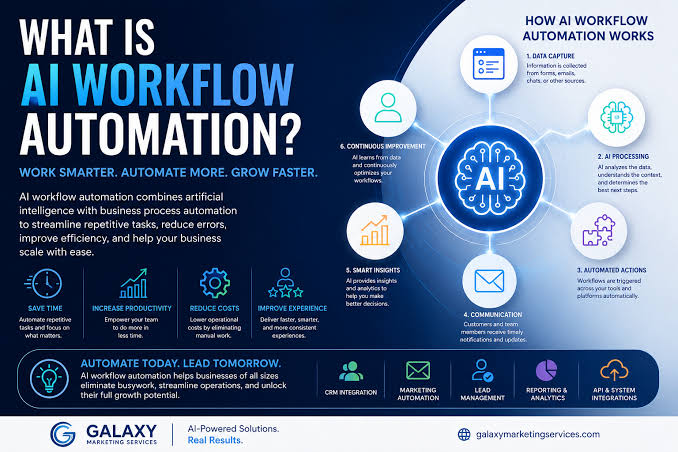
How AI and Automation Are Transforming Modern Business Operations
Businesses today are handling more data, customers, processes, and digital interactions than ever before. As operations become more complex, traditional manual workflows can make it difficult for teams to maintain speed and efficiency.
Artificial intelligence and business automation are changing how companies manage these challenges. Instead of relying entirely on repetitive manual tasks, organizations can use intelligent systems to automate workflows, analyze information, and support faster decision-making.
What Is AI Automation?
AI automation combines artificial intelligence with automated business processes.
Traditional automation generally follows predefined rules. AI-powered automation can go further by analyzing data, identifying patterns, understanding information, and assisting with decisions.
For example, businesses can use AI automation for:
- Customer support and chatbots
- Lead qualification
- Document processing
- Data extraction
- Email automation
- Sales workflows
- Reporting and analytics
- Internal business processes
How Businesses Are Using AI Automation
1. Automating Repetitive Tasks
Employees often spend significant amounts of time performing repetitive activities such as entering data, organizing documents, sending routine emails, or updating records.
Automation can handle many of these tasks consistently, allowing employees to focus on higher-value activities.
2. Improving Customer Support
AI-powered chatbots and virtual assistants can respond to common customer questions, provide information, and route complex queries to the appropriate team.
This can help businesses provide faster responses while maintaining human support for situations that require personal attention.
3. Making Better Use of Business Data
Modern businesses generate large amounts of information from websites, applications, CRM systems, sales platforms, and customer interactions.
AI systems can help analyze this information and identify useful patterns. Businesses can then use these insights to improve marketing, sales, customer service, and operational planning.
4. Streamlining Internal Workflows
AI automation can connect different software systems and automate processes between them.
For example, when a new lead submits a form, an automated workflow could:
- Capture the lead information.
- Store it in the CRM.
- Categorize the enquiry.
- Notify the sales team.
- Send an acknowledgement email.
- Create a follow-up task.
This reduces the need for employees to manually move information between multiple systems.
Benefits of AI and Business Automation
When implemented around clearly defined business processes, AI automation can provide several operational benefits.
Reduced manual work: Repetitive activities can be automated.
Faster processes: Automated workflows can operate continuously without depending on manual intervention.
Fewer operational errors: Consistent automated processes can reduce mistakes caused by repetitive data entry.
Better scalability: Businesses can handle increasing volumes of work without increasing every manual process at the same rate.
Improved visibility: Connected systems can provide better information about business activities and performance.
Challenges Businesses Should Consider
AI automation is not simply about adding AI tools to existing processes.
Businesses should first understand which processes actually need automation. Poorly designed workflows can create unnecessary complexity instead of improving operations.
Important considerations include:
- Data quality
- Security and privacy
- Integration with existing software
- Human oversight
- Employee training
- Monitoring and maintenance
- Clear business objectives
A successful automation strategy should therefore begin with the business problem rather than the technology itself.
The Future of Business Automation
As AI technology continues to develop, businesses are likely to combine AI capabilities with CRM, ERP, cloud platforms, customer applications, analytics systems, and internal workflows.
The goal is not necessarily to replace every manual activity. Instead, businesses can use automation to reduce repetitive work while allowing employees to concentrate on strategy, creativity, customer relationships, and complex decisions.
Conclusion
AI and automation are becoming important components of modern digital business operations. From customer support and lead management to data processing and internal workflows, intelligent automation can help organizations build more efficient and scalable processes.
Businesses that approach automation strategically — starting with clear processes, reliable data, and measurable objectives — can create technology systems that support long-term operational growth.
EXIM & Logistics Specialist at SkyLink Global Services. Specializing in statutory customs compliance, freight procurement, and international cross-border multimodal routing.